Home & Living · New Mexico
Choosing a Platform Frame for Dry-Climate Comfort
In a dry climate, the bed is more than a soft place to land. It is a small piece of household engineering: a structure that holds a mattress level, leaves room for air to move, and fits the particular rhythms of a New Mexico home.
Published October 19, 2026
There is a particular clarity to a New Mexico morning. Light arrives early and without much ceremony, finding the dust on a windowsill, the edges of a rug, the fine grain of a wooden bed frame. The air may be dry enough to make a glass of water seem urgently useful. In this landscape, a bedroom’s comfort depends on more than the thermostat or the number of blankets within reach. The objects under and around the bed have their own quiet part to play.
A platform frame is among the simplest of those objects. It holds a mattress on a low, often spare structure, usually with slats or a solid deck in place of a separate box spring. Its appeal is partly visual: fewer layers, fewer fussy details, a room that can seem a little less crowded. But the frame is not merely a stage set. Its spacing, height, materials, and construction affect the way a mattress is supported and how air can circulate around it.
For people considering New Mexico beds, those details are worth examining closely. A dry climate does not call for a special category of frame, nor does it guarantee that every bedroom will feel dry or comfortable. Homes vary. Elevation, heating and cooling, window placement, household habits, and the mattress itself all matter. Still, a platform bed chosen with care can provide a stable foundation and help a bedroom feel considered rather than improvised.
Start with the mattress, not the silhouette
It is easy to fall for a bed frame from across a room. The low profile, the clean line of the headboard, the apparent simplicity of a mattress floating just above the floor: these are persuasive qualities. Yet the first practical question is less romantic. What does the mattress require?
Mattresses differ in construction and in the support conditions their makers specify. Some are designed for closely spaced slats; others may require a solid platform or a particular kind of foundation. The relevant guidance is usually in the mattress warranty or care instructions. Read it before buying a frame, and check whether the dimensions and support system match the mattress size. A frame that looks right but allows excessive gaps between slats may not provide the intended support.
That compatibility matters over time. When a mattress rests on an uneven or unsuitable base, pressure may be distributed inconsistently. The surface can feel less stable, and the mattress may not perform as designed. A good foundation cannot correct every issue in a mattress, but it can avoid creating new ones. Think of it as the level ground on which the rest of the sleep system depends.
There is no universal slat measurement that applies to every mattress. The appropriate spacing depends on the mattress’s design and the manufacturer’s instructions. As a general comparison point, closely spaced slats provide more continuous support than widely separated ones. But “closer” is not an independent guarantee of quality: the slats must also be sturdy, properly attached, and supported by a frame that does not flex or rack under ordinary use.
Slat spacing: the small gap with a large job
Slats are the horizontal members that carry the mattress. Their intervals are easy to overlook because they disappear once the bed is made, but they determine how much of the mattress is supported and how freely air can pass underneath. A platform frame’s design is, in part, a negotiation between these two purposes: support and openness.
Begin by measuring the gaps or consulting the maker’s specifications. Then compare the result with the mattress manufacturer’s requirements. If the mattress calls for closely spaced supports, a frame with broad openings may be unsuitable even if it is solidly built. If the mattress is intended for a different foundation, adding a panel or improvised support may alter ventilation and could affect warranty coverage. Better to confirm compatibility than to make a late adjustment with plywood and optimism.
Slat material and construction deserve attention, too. Look for members that sit evenly, do not wobble, and are held securely in place. A central rail or additional support can matter on larger sizes, where the frame must carry more weight across a wider span. A frame should feel steady when someone sits at its edge and should not shift noticeably as the mattress is used. In a quiet room, even a small creak has a way of becoming the evening’s principal event.
Airflow is often cited as a benefit of slatted frames. The openings allow some air movement beneath the mattress, unlike a fully enclosed base. That can be useful as part of ordinary bedroom upkeep, particularly in homes where mattresses are made soon after waking or where ventilation is limited. It should not be confused with climate control. Slats will not regulate the room’s humidity or temperature, and a dry outdoor climate does not tell the whole story about conditions indoors.
What a dry climate changes—and what it doesn’t
New Mexico spans high desert, mountains, river valleys, and communities at varied elevations. A bedroom in Albuquerque may not behave like one in Taos, Las Cruces, or a small town in the southern part of the state. Seasons, insulation, heating systems, evaporative cooling, and daily ventilation create different indoor environments. “Dry climate bedroom” is a useful starting phrase, not a complete description of a particular home.
In generally dry conditions, bedding and wood may feel different from how they do in a humid coastal house. The air can make natural materials seem crisp, and indoor heating in winter may add to a sense of dryness. But a bed frame does not need to be chosen on the assumption that dry air will preserve every material indefinitely. Sunlight, temperature swings, cleaning products, and the way a room is used all contribute to wear. Sensible care remains sensible care, even in a place where rain can feel like a scheduled guest.
The more practical climate question is whether the bed’s construction suits the way the room is ventilated and maintained. Slats leave the underside of a mattress more exposed to circulating air than a closed base does. That may be an advantage for some households, but airflow depends on more than the frame: a mattress placed directly against a wall, a crowded arrangement of furniture, or a room with little air movement can limit it. Leave enough space to clean around the bed and to inspect the floor and underside of the mattress occasionally.
For people who use a humidifier during the driest months, or who have rooms that are cooler and less ventilated, the local indoor conditions may differ from the outdoor climate. Follow the equipment instructions and the mattress maker’s care guidance. Avoid assuming that an open-slatted design can compensate for persistent moisture or ventilation problems; the frame is one part of the room, not a substitute for addressing the room itself.
Height, cleaning, and the space around the bed
Frame height is often discussed as a matter of taste. It is also a matter of use. A low platform can make a room feel open and grounded, an effect that suits spare interiors and smaller bedrooms. A taller frame may make it easier to get in and out of bed, provide storage beneath, or create a more familiar furniture profile. The right height is the one that works for the people using it and the room it occupies.
Measure the combined height of the frame and mattress before settling on a design. The mattress’s thickness can transform a low platform into a much taller bed than expected. Consider bedside tables, reading lamps, and the height of any headboard. A bedside surface that sits far below the mattress can be awkward; one that rises well above it can look imposing. These are minor calculations, but they tend to become obvious at midnight.
Then consider the floor beneath. A frame raised on legs may allow a vacuum or cleaning tool to pass underneath, depending on its clearance. A low or floor-hugging frame can make that space harder to reach. In a dry region, dust is a familiar household fact, and a bed that is easy to clean around may be an everyday advantage. The choice is not simply between modern and traditional styles; it is between different patterns of maintenance.
Storage can change the equation. Drawers or bins beneath the bed are useful when closet space is limited, but they can reduce the open area below the mattress and make cleaning less straightforward. If the bedroom is compact, measure the full footprint, including any drawers that need to extend. Leave a practical route to the bed and enough room to open doors, walk past furniture, and change the sheets without conducting a small expedition.
Material and finish: beyond the first impression
Wood is a natural choice for platform bed frames, but the word alone tells us little. Species, joinery, finish, and construction all affect appearance and durability. Solid wood may show variation in grain and color; engineered components can offer consistent dimensions; reclaimed wood may carry marks from an earlier life. The best choice depends on the desired look, the frame’s structure, and how much visible variation feels appealing rather than distracting.
In a sunny New Mexico room, placement deserves a thought. Strong, direct sunlight can fade or alter many finishes over time, just as it can affect floors, textiles, and books. A bed placed near a bright window may experience more exposure than one on an interior wall. Curtains or shades can help manage sunlight, while routine dusting and gentle cleaning preserve the finish. Use care instructions suited to the material; a harsh cleaner can do more harm than the everyday dust it was meant to remove.
Finishes also influence the impression a bed makes. A clear or matte finish tends to keep attention on the grain, while a darker finish can give the frame more visual weight. In a room already shaped by plaster tones, woven textiles, or warm-colored flooring, the bed may blend in or become a deliberate contrast. The point is not to reproduce a regional style by checklist. New Mexico interiors are varied, and a home can be both locally rooted and entirely personal.
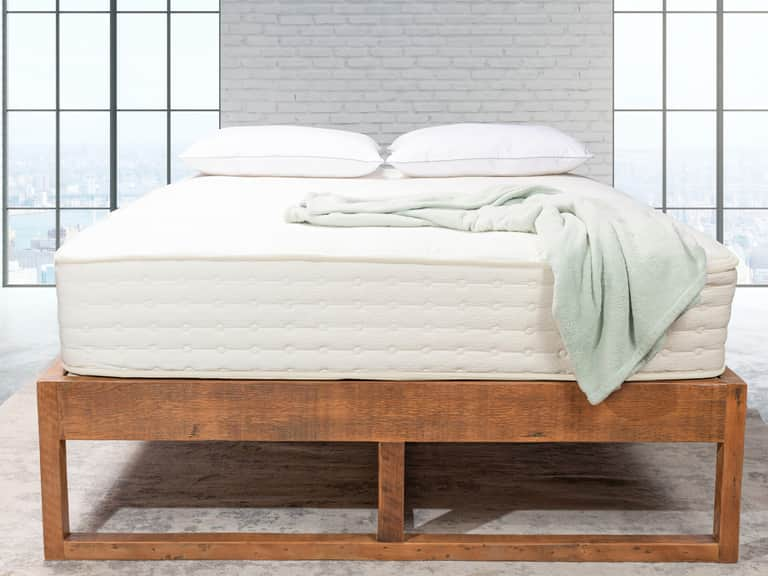
One example within the platform-bed category is The Clean Bedroom Taconic Bed. Its listed construction uses reclaimed wood, a water-based finish, and solid-wood slats spaced no more than 2.5 inches apart. Those details make it relevant to a discussion of platform support and airflow. Anyone considering it—or any frame—should still check the current specifications against the requirements of their own mattress, confirm dimensions, and review care and assembly information.
A quieter room is built from small decisions
Minimalism can be a useful design principle, but it is not a test of virtue. A room does not become more restful simply because it contains fewer objects. What matters is whether the layout supports daily life: whether the bed feels stable, the path through the room is clear, the mattress rests on an appropriate foundation, and the surfaces can be cared for without undue effort.
Platform frames are often associated with clean lines because the support system is integrated into the bed. That simplicity can make a small bedroom feel less crowded and can leave room for the details that matter more to its occupants: a chair, a reading light, a quilt, or nothing at all. But a spare appearance should not conceal weak construction. Check the joints, the rail connections, the center support where applicable, and the way the slats are secured. A beautiful outline is only useful if the structure holds its shape.
Noise is another practical consideration. A frame that shifts or squeaks can interrupt sleep and make ordinary movement feel amplified. Loose joints, uneven floors, and mattress movement can all contribute. During assembly, follow the maker’s instructions and tighten hardware as directed. If a frame later begins to creak, inspect the connections and floor contact before assuming the mattress is at fault. Felt pads may help where appropriate, but they are not a cure for a poorly assembled or damaged structure.
A measured checklist before buying
Before comparing finishes or deciding whether a headboard belongs in the picture, gather the facts that determine whether a frame will work. A short checklist can prevent a long return process:
- Confirm the mattress size and read its support and ventilation requirements.
- Check slat spacing, slat construction, and whether the frame includes center support where needed.
- Measure the room, the bed’s full footprint, and the combined frame-and-mattress height.
- Consider cleaning access beneath the bed, as well as clearance for doors, drawers, and bedside furniture.
- Review materials, finishes, assembly instructions, weight guidance, and care recommendations.
- Think about direct sunlight, heating, ventilation, and how the room is used through the seasons.
These questions are not glamorous, but neither is discovering that the new bed blocks a closet door or cannot support the mattress as required. A useful frame is one that disappears into the routine of the room. It should hold its load, keep the mattress properly supported, and allow the household to move around it without special arrangements.
The foundation of a New Mexico bedroom
There is no single frame that suits every home across the state. A compact apartment, a mountain cabin, and a sunlit house on the high desert plain ask different things of their furniture. The durable principles are more modest: match the foundation to the mattress, choose spacing and construction that provide appropriate support, make room for cleaning and circulation, and select materials that fit the way the bedroom is lived in.
Dry air may be part of the setting, but it is not the whole story. Comfort comes from the relationship between frame, mattress, room, and routine. When those pieces work together, the platform bed does not announce itself. It simply stands there, quiet and level, while the day begins beyond the window and the night waits, somewhere in the house, to return.